
Newsroom

Building Galaxies from Scratch: International Conference on Galaxy Simulations Draws Over 100 Researchers to Heidelberg
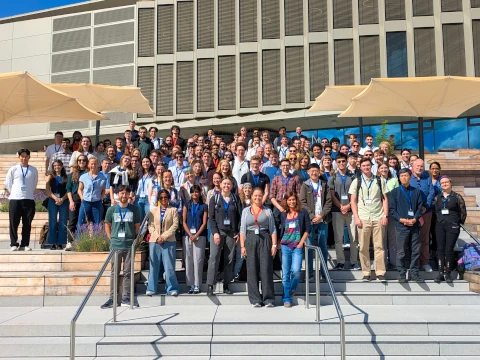
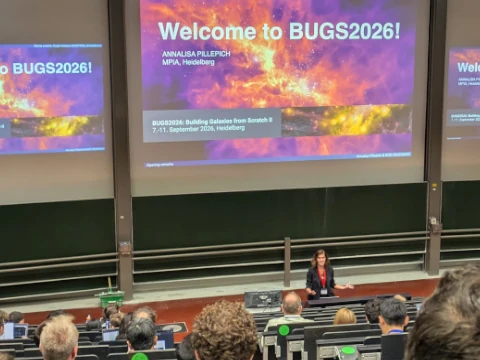
From 7 to 11 September 2026, the second edition of the international conference “Building Galaxies from Scratch (BuGS) – Advances and Challenges in Simulating Galaxy Evolution” took place at Heidelberg University. More than a hundred researchers came together for five days of discussions on the latest advances in understanding how galaxies form and evolve through numerical simulations.
The programme featured more than 80 presentations, including 10 invited lectures, as well as about 40 posters. Posters were introduced in four dedicated flash-talk sessions, while a poster quiz on Thursday encouraged participants to read and engage closely with one another’s work. A prize was awarded for the best poster and another one for the winner of the poster quiz.
Across the five days, participants discussed recent advances and challenges in cosmological simulations of galaxy formation and evolution. As these simulations have matured into predictive frameworks reproducing key cosmological observations, researchers are working to understand which ingredients are essential, where current models fall short, and how upcoming generations of simulations can improve on them.
Topics included the treatment of the multiphase interstellar and circumgalactic media, stellar and AGN feedback, magnetic fields, and cosmic rays. Aside from the discussion of new and existing simulation models, attention was given to the creation and analysis of synthetic observations as well as to galaxy formation at high redshift, prompted by recent JWST observations. The programme also addressed the numerical and computational foundations of the field, from new hydrodynamical approaches to strategies for running simulations efficiently on modern GPU architectures.
A particular strength of the conference was its breadth: the event brought together developers and users of nearly all the major cosmological simulation projects and simulation codes in one room: code builders, physics modellers and theorists with a keen eye on observations.
“While the scientific programme was of a very high standard and the discussions were at times lively, the atmosphere throughout the conference remained very collegial and friendly. There were many questions after the talks and a good level of engagement from the participants. A particularly nice example of this was the grass-roots organisation of a 'simulation movie night', which brought participants together in a more informal setting.” – Annalisa Pillepich (organizer)
The conference was organized by a scientific committee drawn from institutions across Europe, chaired by Annalisa Pillepich (MPIA), and hosted in Heidelberg by MPIA and Heidelberg University. The event was supported by the STRUCTURES Cluster of Excellence and by the EU through the ERC grant COSMIC-KEY (101087822, PI: Annalisa Pillepich).
Further information: