
Newsroom

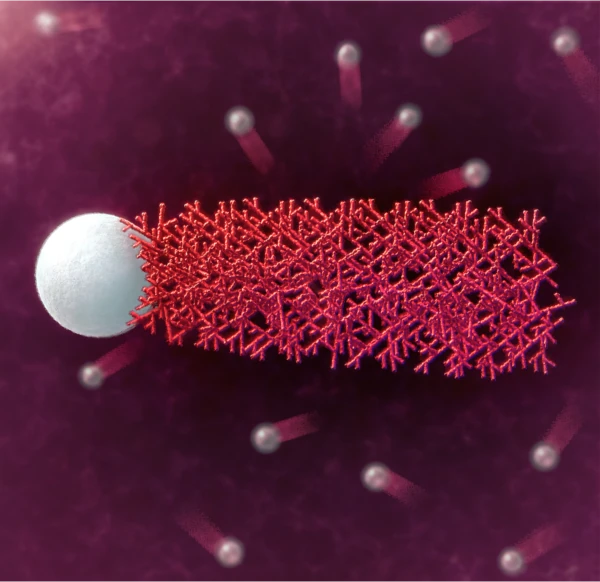
Biological cells are the smallest living units of an organism. To maintain their shape, divide, and move, they rely on the cytoskeleton, which is made from biopolymers like actin. Actin assembles into filaments and larger networks, which constantly undergo renewal, as monomers are added, removed, and re-used elsewhere. This dynamic behaviour allows the cell to rapidly adapt to changing environmental conditions. At the same time, this poses a problem: the different actin structures compete for a shared limited pool of free actin monomers. If one structure consumes more, less remains for the others, causing them to shrink, as they lose actin faster than they can replace it. Yet, one observes that multiple distinct structures can coexist at stable sizes. This raises the question of which mechanism prevents single structures from monopolizing the shared pool.
In a new study, STRUCTURES scientists Valentin Wössner, Falko Ziebert and Ulrich Schwarz have made substantial progress in solving this puzzle. They developed a theory for coexistence and selection of branched actin networks – going beyond earlier models that had focused mainly on single filaments and bundles. Using ordinary differential equations (ODEs) and bifurcation analysis, their framework shows how local depletion of actin can provide a natural self-regulating mechanism: as a dense network grows, it uses up the free actin at its leading edge, slowing its own further growth. When competition becomes too strong, coexistence gets replaced by selection. The new theory bridges so-called limited pool models and the growth physics of branched actin networks.
Methodological exchange between the disciplines of biophysics and scientific computing proved crucial for validating this result. In addition to analytical modelling, the researchers solved partial differential equations (PDEs) describing the spatial distribution of actin to confirm their predictions in greater detail for selected cases. These simulations were carried out using a module of the numerical software framework DUNE – which has been co-developed by STRUCTURES member Peter Bastian. The close agreement found between both approaches supports the ODE model as an effective description of the dynamics.
Further information:
Valentin Wössner is a doctoral researcher at the Institute for Theoretical Physics (ITP) and at BioQuant, and a member of the STRUCTURES Young Researchers Convent (YRC). Ulrich Schwarz is Professor of Theoretical Physics at the Institute for Theoretical Physics (ITP) and BioQuant, and a Principal Investigator in STRUCTURES' Comprehensive Project CP3 (From Molecules to Cells and Tissue). Falko Ziebert is a Privatdozent at the Institute for Theoretical Physics (ITP) and a full member of STRUCTURES. Peter Bastian is a Professor of Scientific Computing at the Interdisciplinary Center for Scientific Computing (IWR) and also a Principal Investigator in CP3 of STRUCTURES.
Weblinks: