Newsroom


Researchers from across mathematics, astrodynamics, industry, and government gathered at the University of Surrey from 8–11 June 2026 for Geometry Space Surrey, a first-of-its-kind workshop dedicated to exploring how symplectic geometry – a branch of pure mathematics – can inform space mission design. A joint initiative co-supported by the STRUCTURES Cluster of Excellence, the Surrey Space Centre, the University of Surrey's School of Mathematics and Physics, and the Institute of Mathematics and its Applications, the event successfully gathered two traditionally isolated communities to foster new interdisciplinary collaborations.
While mathematical breakthroughs in the early 2010s began to link these fields, the workshop represented one of the first coordinated efforts to bridge the gap between astrodynamicists and mathematicians on a global scale. The workshop attracted 45 participants from eight countries and across all career stages – with a diverse mix of approximately 55% space engineers and 45% mathematicians. Beyond academia, the event included representatives from government agencies and the space industry to ensure a feedback loop between theoretical research and regulatory constraints.
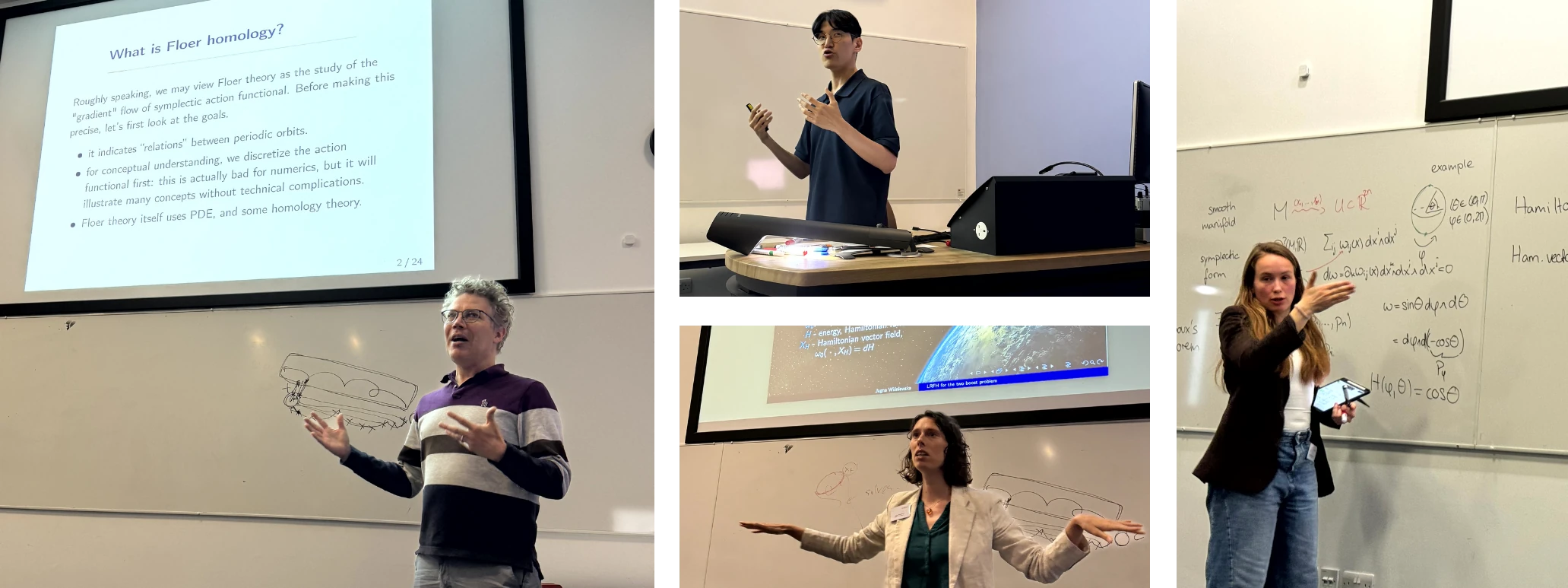
Over four days, the workshop featured 20 research talks, five keynote presentations, a specialized mini-course and a tour through the satellite manufacturing facilities of Surrey Satellite Technology Ltd (SSTL). Sessions explored the Three-Body Problem and Computational Geometry, Cislunar Space Situational Awareness, Geometric optimal control, Floer theory and Contact Geometry. Researchers discussed questions such as using mathematical invariants for end-of-life satellite disposal or applying Floer theory to solve the “two-boost problem” for rocket travel between the Earth and the Moon – a prominent question in space mission design that asks whether a rocket can travel between any two points in the gravitational field of the Earth and the Moon using its engines only at the beginning and at the end of the journey.
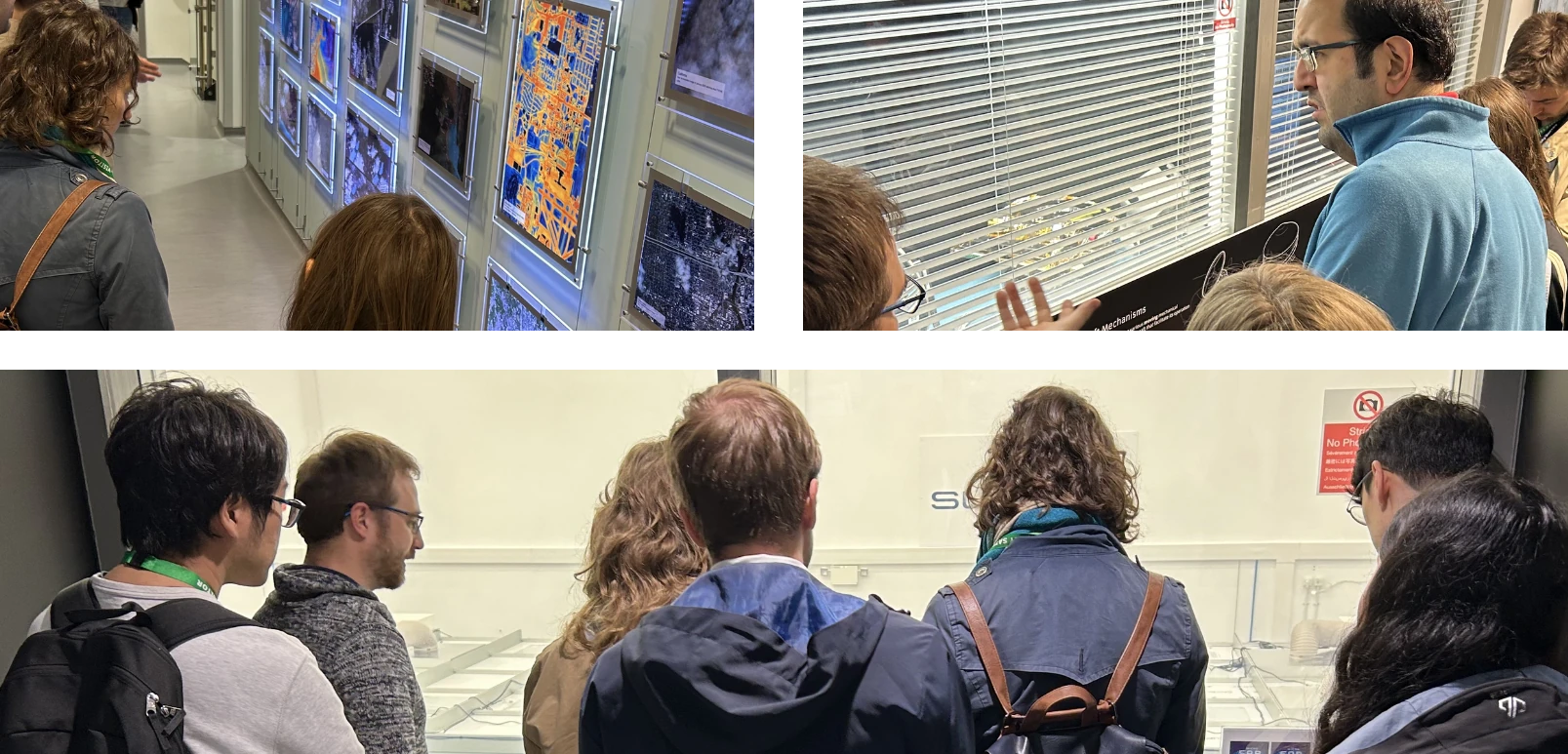
“The goal was to open doors to the wider space sector and establish a direct connection between theory and application,” notes Dr Arthur Limoge (Postdoctoral Researcher at the Surrey Space Centre, and alumnus of the STRUCTURES YRC), who led the organization of the workshop alongside Dr Nicola Baresi and Prof. David J.B. Lloyd from the University of Surrey. This mission was underscored on the final day, when more than half of the participants toured the facilities of SSTL, an international leader in small satellite manufacturing that originated at the University.
Geometry Space Surrey was organised by the Surrey Space Centre with support from the School of Mathematics and Physics at the University of Surrey, the STRUCTURES Cluster of Excellence at Heidelberg University, and the Institute of Mathematics and its Applications. The workshop demonstrated the growing importance of interdisciplinary collaboration in addressing both fundamental scientific questions and practical challenges in the future of space exploration.
About the Surrey Space Centre
Founded in 1979 at the University of Surrey, the Surrey Space Centre is a world leader in small satellite technology. It provides the UK with unique end-to-end capability in satellite development, from orbital mechanics and spacecraft design to mission operations and lunar habitat research.
Further information: