
Newsroom

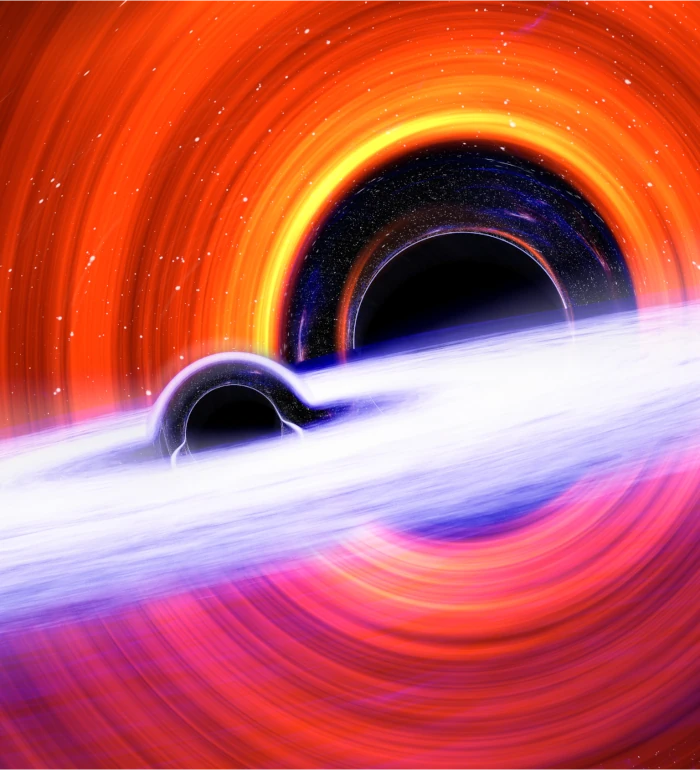

Image credits: Derek Davis / University of Rhode Island / LIGO – Virgo – KAGRA.
The international LIGO–Virgo–KAGRA (LVK) Collaboration has released its latest catalogue of gravitational-wave detections, adding 161 new events observed between April 2024 and January 2025. The new data reveals evidence for the existence of second-generation black holes, provides the most precise sky localization ever achieved for a gravitational wave source, and offers the first measurement of three vibrational modes of a black hole.
The international network of gravitational wave detectors LIGO, Virgo and KAGRA (LVK) has announced today the online release of an updated catalogue of all gravitational wave events observed to date, named the Gravitational Wave Transient catalogue-5.0 (GWTC-5), with the corresponding scientific papers in submission to Astrophysical Journal and Astrophysical Journal Letters. The data analysed in this work were collected by the detectors between April 2024 and the end of January 2025, during a portion of the fourth observing run known as O4b. During this period, 161 new gravitational wave events were detected, bringing the total number of confirmed events observed by the network since the first detection in 2015 to an astounding 390. The international LVK network consists of the twin detectors of the US National Science Foundation Laser Interferometer Gravitational-wave Observatory (NSF LIGO) , the Virgo detector hosted by the European Gravitational Observatory in Italy and the Japanese KAGRA hosted by the Institute for Cosmic Ray Research (ICRR) of the University of Tokyo.
The new catalogue of gravitational wave events allows researchers to study black hole populations in unprecedented detail. “The new catalogue is a gold mine of discoveries, but it also poses new challenges,” says Michela Mapelli, STRUCTURES professor at the Center for Astronomy of Heidelberg University and directly involved in the studies. “For example, the spins – that is, the magnitudes and orientations of the rotations – of the components of two new binary black hole systems, GW241011 and GW241110, are exactly what we expect for second-generation black holes: black holes formed through the merger of smaller black holes.” At the same time, the new study finds that the masses of these black holes, about 10–20 times the mass of the Sun, are lower than predicted by most theoretical models. “This is a new enigma that will keep compact-object astrophysicists busy for quite some time!” says Michela Mapelli.
The new study also provides the most precise sky localization ever obtained for a gravitational-wave source. A signal known as GW240615 was identified within an area of just 6 square degrees, a very small portion of the celestial sphere. This exceptional performance was achieved thanks to the triangulation using data from all three detectors. At the same time, the catalogue includes the “clearest” gravitational wave signal ever detected, with a signal-to-noise ratio of 76.9. This signal, GW250114, reached Earth on January 14, 2025 and was generated by the merger of two black holes with nearly identical masses. After the collision, a newly formed black hole “rings” as it settles into its final shape – similar to how a bell vibrates and produces different tones. For the first time, scientists were able to measure multiple such “tones” – or vibrational modes – in a black hole signal, offering a new way to test Einstein’s theory of general relativity under extreme conditions. The results were in agreement with the predictions of general relativity.
Michela Mapelli is a STRUCTURES Professor working at the Center for Astronomy of Heidelberg University (ZAH), where she leads the group “DEMOBLACK - Demography of Black Hole Binaries in the Era of Gravitational-Wave Astronomy”. Her main research focus is understanding the formation of astrophysical black holes. Prof Mapelli joined STRUCTURES in 2023.
The LIGO–Virgo–KAGRA (LVK) Collaboration is the international network operating the world’s leading gravitational-wave observatories: the two LIGO detectors in the United States, Virgo in Italy, and KAGRA in Japan. Together, the collaboration brings together several thousand researchers from hundreds of institutions worldwide to detect and study gravitational waves from colliding black holes, neutron stars, and other compact-object mergers.
Further information: