
Newsroom

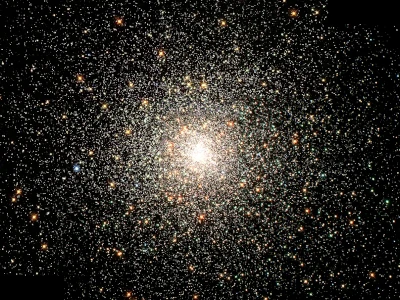
The biggest black holes in the Universe may not be born from collapsing stars. A new study involving STRUCTURES professor Michela Mapelli and collaborators at Cardiff University suggests they instead form through violent merging events in very densely populated star clusters.
The researchers analysed the new LIGO-Virgo-KAGRA Gravitational Wave Transient Catalog to test whether the heaviest black holes were, in reality, second generation objects formed after successive merging processes in a star cluster. In the data analysed, the authors found two different populations, a low-mass one consistent with ordinary stellar collapse and a higher-mass population, whose rapid, randomly oriented spins are a signature of repeated merging in dense star clusters.
The results of this study, published in Nature Astronomy, provide new evidence for the long-predicted pair-instability mass gap – a “forbidden” mass range for black holes made from stars. While gravitational-wave observations have detected black holes lying within that range, the new analysis suggests that these objects are likely merger-built black holes, not ordinary “first-generation” black holes formed directly from stellar collapse.
The findings highlight how gravitational-wave astronomy is moving beyond simply counting merger events. Observations can now be used to verify new theories, allowing scientists to probe the birth, life, and death of black holes. Such information will help us understand the evolution of stars and clusters in the Universe and challenge current models of stellar evolution. Progress is also expected in nuclear physics, where the mass limit set by pair instability depends on nuclear reactions in the cores of massive stars.
The research was carried out by an international team of scientists led by Cardiff University, with contributions from institutions including Heidelberg University's Center for Astronomy (ZAH) and the STRUCTURES Cluster of Excellence. Cardiff University is one of Britain’s leading research universities, and a member of the Russell group of the UK most-research intensive universities. Heidelberg University is Germany’s oldest university and, as a leading European research institution, member of Germany’s Excellence Strategy.
Further information: